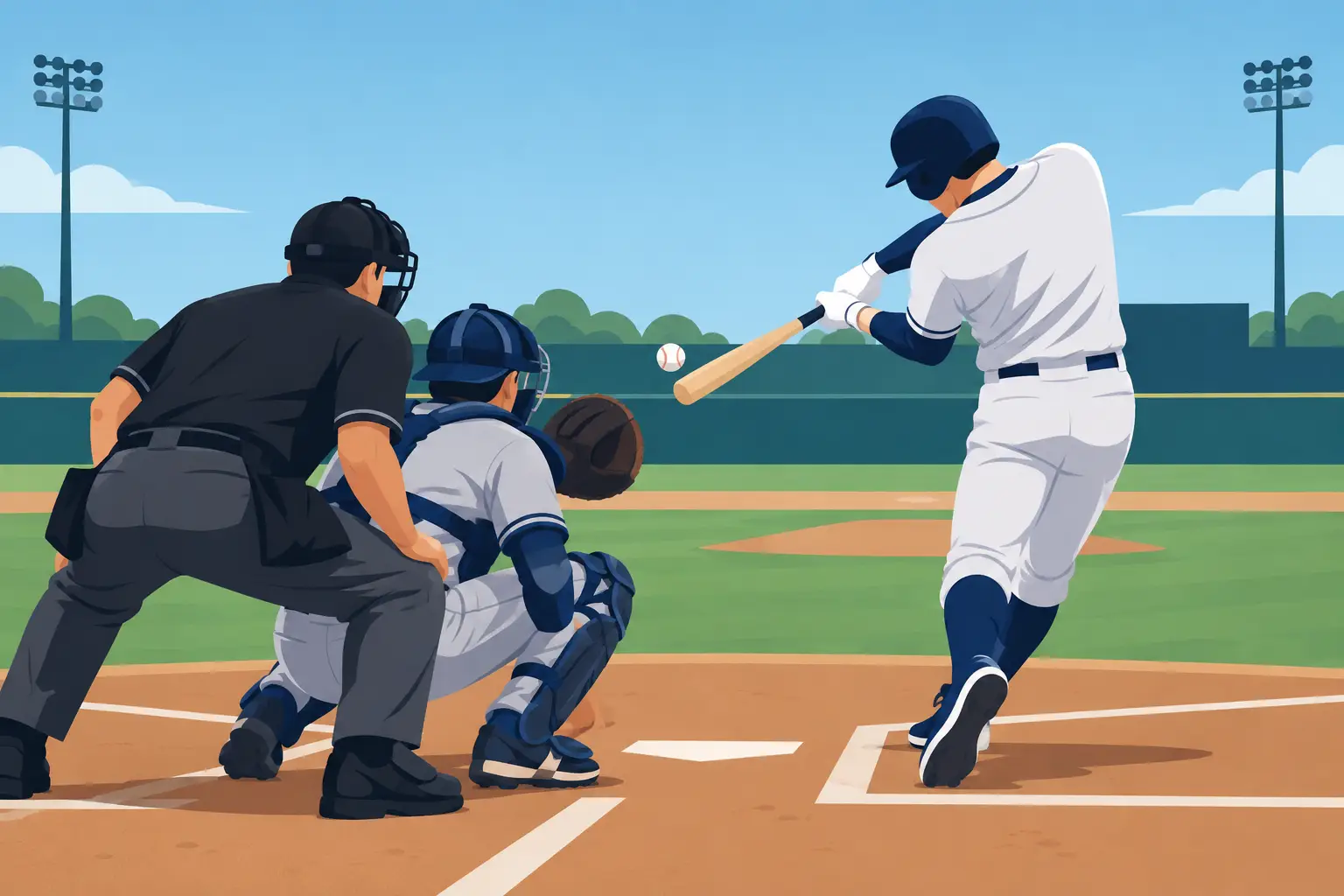
A close play at first can turn a quiet ballpark into a debate in seconds. Was it a force play? Did the runner beat the throw? Was the ball live after it skipped away? Baseball terminology gives everyone a shared language for answering those questions without guessing. Once the words are clear, the rules and the umpire’s decisions make far more sense.
You do not need to memorize an entire rule book to follow a game confidently. Start with the terms that describe what is happening on the field, then connect those terms to common plays. That approach helps parents understand youth games, players make smarter decisions, coaches communicate more precisely, and developing umpires explain calls with confidence.
Why Baseball Terminology Matters
Baseball has plenty of everyday words that carry a specific rules meaning. A “tag,” for example, is not simply a fielder touching a runner. The fielder must touch the runner with the ball securely held in a hand or glove. A runner who slides past a base is not automatically out, either. Whether the runner can return safely depends on the play, the base, and whether a force is still in effect.
Those details matter because the rule is often different from what people assume they saw. Using the correct term helps separate the facts of a play from the emotion around it. Instead of saying, “He had to slide,” ask whether the runner was required to avoid a tag. Instead of saying, “That was interference,” ask who hindered whom and whether the ball was live.
The terminology can vary slightly among professional, college, high school, and youth rule codes. The central ideas are usually similar, but the exact penalty or mechanic may not be. When a game situation matters, always use the rule set for that level of baseball.
Baseball Terminology for the Ball and Field
Fair ball and foul ball
A fair ball is a batted ball that settles or is first touched in fair territory, passes first or third base in fair territory, or meets another rule-based condition for being fair. A foul ball is a batted ball that does not meet those conditions and lands or is touched in foul territory.
The important point is that the ball’s path alone does not decide fair or foul. A ball can roll over a base in fair territory and then curve foul farther down the line. If it has not been touched and does not meet another fair-ball condition, it can still be foul. The base lines and the position of the ball when it is judged are what matter.
Live ball and dead ball
A live ball is in play. Runners may advance, fielders may make plays, and the action continues. A dead ball is not in play, so runners generally cannot advance and fielders cannot make a play until the umpire puts the ball back in play.
A foul ball is a common dead-ball situation. A hit batter is another common example. But not every unusual event creates a dead ball. If a catcher misses a pitch and the ball remains live, a runner may be able to advance. Knowing whether the ball is live is often the first question to ask after any strange play.
The batter’s box, baseline, and base path
The batter’s box is the marked area where the batter stands. A batter is expected to remain in the box during a pitch, subject to the rules and exceptions that apply at that level.
People often say a runner is “out of the baseline,” but the more accurate term is usually the base path. A runner does not have a fixed three-foot lane drawn from one base to the next. The runner’s base path is established when a fielder with the ball attempts to tag that runner. The runner may not run more than three feet away from that path to avoid the tag.
That is why a runner can take a wide turn around a base legally but cannot make a dramatic detour to escape a fielder trying to apply a tag.
Terms That Explain Outs and Advances
Force play and tag play
A force play occurs when a runner is required to advance because the batter becomes a runner. With a runner on first and a ground ball hit to an infielder, the runner from first is forced toward second. The defense can retire that runner by touching second base with the ball before the runner arrives.
A tag play requires the defense to tag the runner. If a runner is on second with first base open and the batter hits a ground ball, that runner is not forced to third. Touching third base will not retire the runner. A fielder must tag the runner, unless the runner is forced later by a different situation.
Forces can disappear. If the lead runner is retired, the batter-runner is put out, or a runner reaches the base that removes the obligation to advance, a force may no longer exist. This is one of the biggest reasons a simple ground ball can become confusing near the bases.
Appeal play
An appeal is a play in which the defense points out that an offensive player failed to follow a requirement, such as missing a base or leaving a base too soon on a caught fly ball. The defense must appeal properly under the applicable rule code. Umpires do not usually call a missed base on their own just because they noticed it.
For example, a runner may touch home safely after a hit but miss third base along the way. If the defense recognizes it and appeals third correctly, the runner can be declared out. The timing, ball status, and method of appeal can matter, so this is an area where rule-code details are especially important.
Appeal versus interference
An appeal is not an argument about a judgment call. It is a request for the umpire to rule on a specific rules violation. Interference is a different concept entirely: an act that illegally hinders, impedes, confuses, or obstructs a player who is trying to make a play.
The words sound technical, but the practical question is simple: Did someone improperly affect the other team’s opportunity to play baseball?
Calls People Commonly Mix Up
Interference and obstruction
In most baseball usage, interference involves the offense improperly hindering the defense. A runner who collides with a fielder trying to field a batted ball, or a batter who interferes with a catcher’s throw, may create interference.
Obstruction generally involves the defense illegally hindering a runner. A fielder without the ball and not in the act of fielding a batted ball cannot block a runner’s access to a base or alter the runner’s path without consequence.
The penalty depends on the situation. Some interference calls result in an immediate dead ball and an out. Some obstruction situations allow play to continue before the umpire protects the runner. Do not assume every collision is interference or that every blocked path is automatically the same ruling.
Balk and illegal pitch
A balk is an illegal act by a pitcher while there are runners on base. It is designed to prevent the pitcher from deceiving runners unfairly. Common discussions involve failing to come to a complete stop from the set position, making an improper feint, or starting a motion and not delivering the pitch.
An illegal pitch is related but not identical. Its definition and penalty can differ by rule code and whether runners are on base. The best habit is to identify the pitcher’s position, the action that occurred, and the level of play before deciding what the call should be.
Catch, trap, and transfer
A catch requires secure possession of a batted ball or thrown ball before it touches the ground, along with voluntary release or clear control after a collision or fall. A ball that hits the ground before the fielder secures it is not a catch, even if the fielder closes the glove quickly afterward.
A “trap” is the common word for a ball fielded just above the ground or after contact with the ground. The word is useful in conversation, but the rule question is whether the fielder caught the ball cleanly. On close plays, an umpire must judge control, ground contact, and the fielder’s actions after the ball enters the glove.
Learn the Words Through Real Plays
The fastest way to build baseball vocabulary is to connect each term to a familiar situation. Watch a runner steal second and ask whether the throw was late, whether the tag was applied, and whether the ball came loose before the tag was completed. Watch a fly ball and ask whether runners must tag up, whether a catch was made, and whether an appeal could follow.
Keep the focus narrow. Learn the difference between a force and a tag play before tackling appeal procedures. Understand live-ball action before trying to sort out complicated interference penalties. Learning the rules of baseball does not have to be a full-time job when the terminology is presented clearly and tied to the plays you actually see.
Baseball Rules in Black and White is built for that kind of practical learning, with plain-language explanations and video-supported instruction available when a question comes up before, during, or after a game. The next time a call starts a debate, begin with the right term. Often, that is the shortest path to the right answer.